
Reliable color measurement turns color into objective, repeatable values, from incoming goods inspection in the laboratory to continuous monitoring on the production line. LabroTek supplies ColorLite spectrophotometers, designed and manufactured in Germany, including portable, benchtop and inline instruments as well as a transmission densitometer. With a wide selection of measuring heads and sample accessories, you can measure solids, powders, granules, liquids and films with one consistent method.

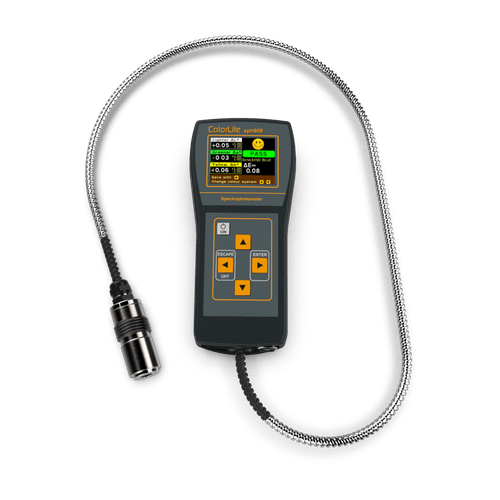
Handheld color measurement for quality control wherever the sample is:
Laboratory instruments for the highest accuracy and stability:
Continuous color monitoring directly in the production process:
Adapt one spectrophotometer to many sample types:
Precise optical density measurement of films and other transparent materials:
Our specialists help you identify the ideal equipment for your specific applications and requirements
Professional setup and comprehensive operator training to ensure optimal performance from day one
Dedicated assistance throughout your equipment's service life, including troubleshooting and updates
Regular service programs to maintain accuracy, compliance, and maximize operational uptime
ColorLite spectrophotometers combine laboratory-grade optics with simple operation, providing:
A holographic grating spectrometer scans the visible range from 400 to 700 nm in 3.5 nm steps for accurate, repeatable color values
45°/0° and d/8° geometries according to DIN 5033, plus d/0° probe heads with large measuring areas for granules and other inhomogeneous samples
White and blue high-power LEDs with a service life of over 20 years give stable results and low maintenance costs
ΔE*ab, ΔE CMC, ΔE94 and ΔE2000 with pass/fail tolerances, plus whiteness, yellowness and metamerism indices depending on the model
ColorDaTra quality control software, USB and wireless connection, optional barcode scanning and industrial interfaces for inline systems
A spectrophotometer lights the sample with a defined light source and measures how much light is reflected or transmitted at each wavelength across the visible spectrum. ColorLite instruments scan from 400 to 700 nm in 3.5 nm steps. From this spectral curve, the instrument calculates color values such as CIE L*a*b* for a chosen illuminant and observer. This makes color objective and comparable between batches, sites and suppliers.
With 45°/0° geometry, the sample is lit at a 45° angle and measured at 0°. The result is close to how the human eye sees color, including the effect of gloss and surface texture, so it suits visual appearance control. With d/8° geometry, an integrating sphere lights the sample diffusely and the measurement is taken at 8°. Because the gloss component is included, the result depends less on the surface finish, and d/8° is widely used for color formulation and for comparing materials with different surfaces. Benchtop instruments with a gloss trap, such as the ColorLite ColorTube, can switch between specular component included and excluded (SCI/SCE).
ΔE (delta E) is a single number that describes the total color difference between a sample and a reference standard. The larger the value, the bigger the visible difference. There are several formulas, such as ΔE*ab, ΔE CMC, ΔE94 and ΔE2000, and the newer ones match human color perception more closely. In quality control, a ΔE tolerance is usually set for each product, and the spectrophotometer then gives a clear pass or fail result.
Yes. With the right sample accessories, one portable spectrophotometer can handle many sample types. Powders are measured in glass cuvettes, granules and other inhomogeneous samples with d/0° probe heads that have a 38 mm or 80 mm measuring area, and liquids in cuvettes in reflection or transmission. Films and thin plastic sheets can be measured in transmission with a dedicated holder.
Portable spectrophotometers are ideal for incoming goods inspection, spot checks in production and measurements on large or installed parts. Benchtop spectrophotometers offer the highest accuracy and stability for laboratories, color formulation and transmission measurements. Inline systems measure continuously in the production process, so color deviations are detected immediately and waste is reduced. Many companies combine a benchtop instrument in the lab with portable or inline instruments in production, and our experts help you find the right combination.
A transmission densitometer measures how much light passes through a transparent or translucent material and expresses the result as optical density. Typical applications are tinted plastic films and other light-transmitting materials, especially in the automotive industry where density values must be very precise. The ColorLite sd350 measures density values from 0 to 6 D with a repeatability of ±0.003 D at 3 D and also records the full spectral transmission curve.
Daily use starts with a quick calibration against the white standard supplied with the instrument, and on some models also a black reference. ColorLite instruments can remind the user when a new calibration is due based on time or temperature. In addition, we recommend a regular check of the instrument and its standards, typically once a year, to keep results traceable. LabroTek offers calibration and service for all the color measurement instruments we supply.
Yes. LabroTek supplies ColorLite color measurement instruments and provides local support for them. We help you select the right instrument and accessories, and we take care of installation, operator training, calibration and service. Inline systems are tailored to your production line together with ColorLite.